

Brands invest significantly in sustainability communication through advertising, social media, websites, and PR. But the most carefully crafted message only works if it reaches consumers where they learn about eco-friendly products. The data reveals a fragmented and channel-diverse picture that brands maybe not be fully accounting for.
Internet search leads as the top source of eco-friendly product information. Packaging ranks second, making it the highest-reach channel where brands shape the message directly.
Internet search (e.g., Google, AI platforms, and YouTube) at 38%, is the top source for information about eco-friendly products by a meaningful margin. This is an active, intent-driven behavior: consumers seeking information rather than passively encountering it. Product packaging and labels (33%), social media (33%), word of mouth (31%), and news media (31%) follow closely. The clustering of these sources means that no single channel dominates; consumers are assembling eco-friendly product information across multiple touchpoints simultaneously.
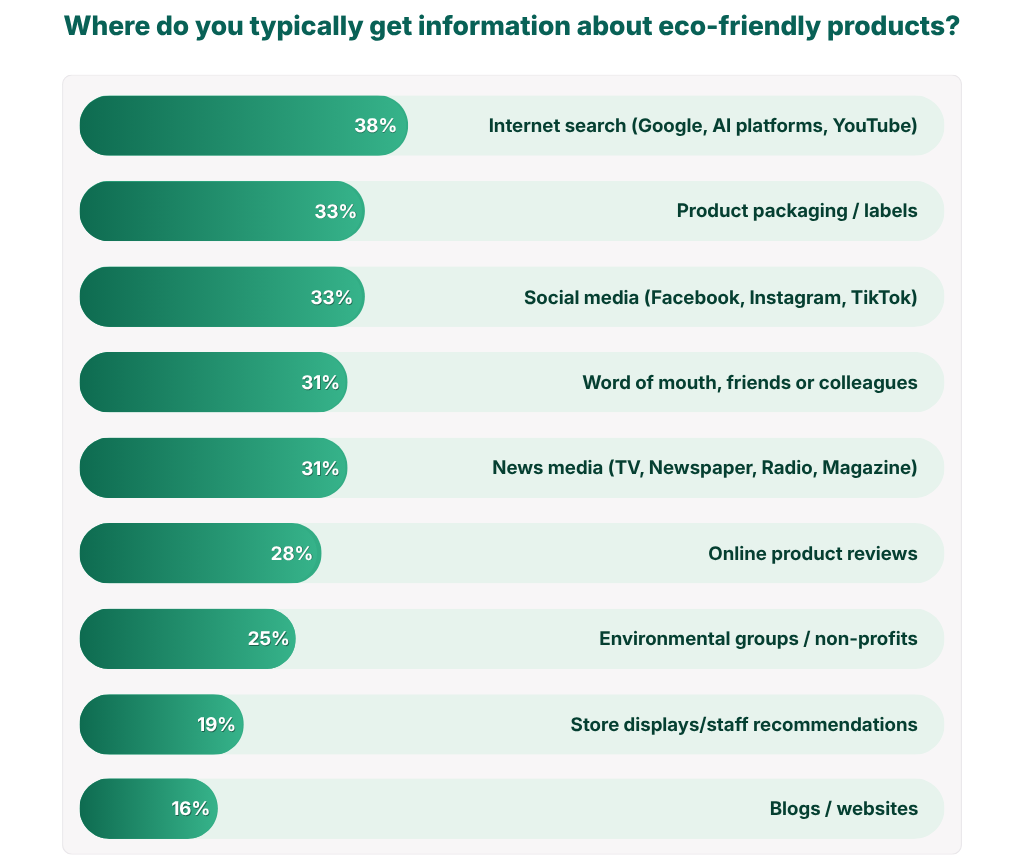
The most strategically significant finding for brands is where packaging and labels sit in this ranking. At 33%, packaging is the channel where brands have the most direct influence over the message. Every other top source involves a third party like a search algorithm, a social platform, a journalist, or a peer. Packaging is where brands speak directly to consumers at the moment of purchase, and the data suggests it is one of the highest-reach sustainability communication tools available.
The broader picture is one of simultaneous, multi-channel discovery. Consumers are not relying on any single source for eco-friendly product information. They are finding it through search, packaging, social media, and peers at the same time. Brands that show up consistently and credibly across those touchpoints are more likely to be found, trusted, and chosen than those concentrating investment in one channel alone. Search visibility and packaging as a strategic communication tool are the two areas where brands can act most directly. Social media and word of mouth round out the picture as channels worth activating even if they are harder to influence.
What's the Takeaway?
Consumers use multiple channels to find eco-friendly product information, and no single source dominates. Invest in search visibility as consumers actively looking for eco-friendly products are a high-intent audience. Treat packaging as a strategic sustainability communication tool, not a compliance exercise as one in three consumers are using it as an information source. And activate social and peer channels, where word of mouth and reviews remain meaningful parts of how eco-friendly product information travels.