



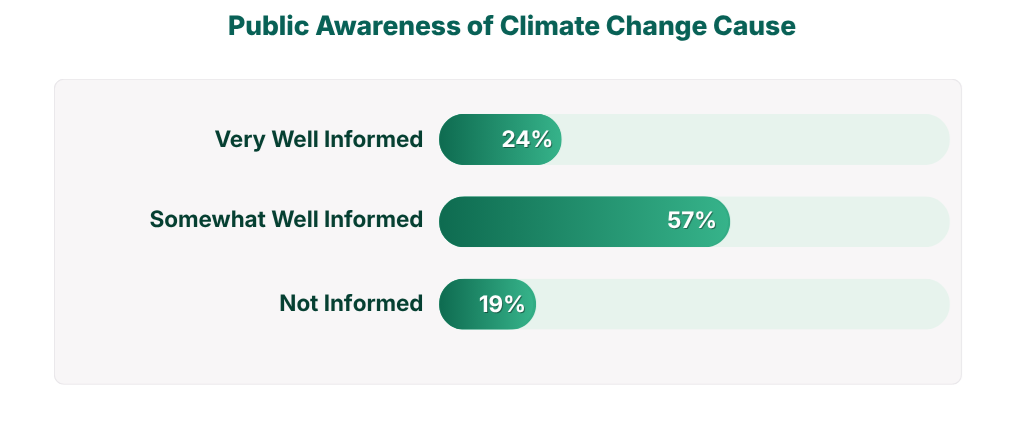
Most Americans feel only partly informed about climate change
Climate change is one of the most discussed environmental issues of our time — yet most Americans approach it with a degree of hesitation about what they actually know. Only 24% consider themselves very well informed about the causes of climate change, while 57% say somewhat informed and 19% say not informed at all. That is not necessarily a failure of communication — climate science is genuinely complex, and a measure of uncertainty is both rational and intellectually honest. But it does tell us something important about the audience that climate communication needs to reach.
The real climate divide isn't believe or deny — it's about how much is man-made
On the question of whether climate change exists, there is broad consensus — 89% acknowledge it in some form. But the more nuanced and telling finding is in how people understand its causes. Only 35% attribute climate change primarily to human activity. The largest single group — 39% — sees it as a combination of natural and man-made factors, which is not an unreasonable position given that science does acknowledge the role of natural variability alongside human influence. A further 15% believe it is mostly a natural phenomenon, and 11% remain uncertain it exists at all.
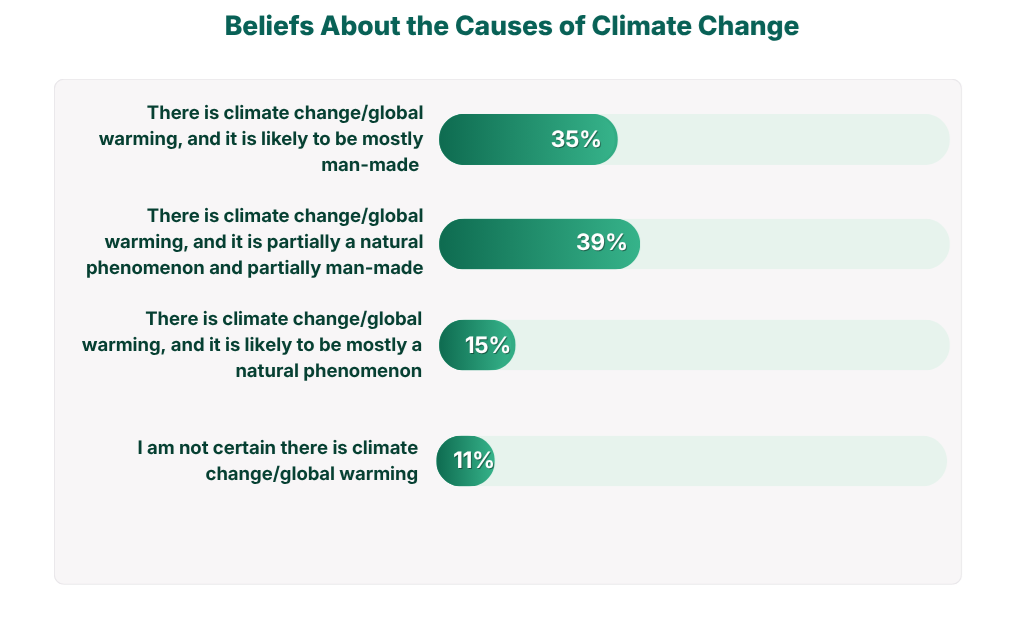
The picture that emerges is not one of denial — it is one of a large middle ground. Most Americans accept the reality of climate change but hold genuinely mixed views on the degree of human responsibility. And therefore, what, if anything they can do to affect change.That distinction matters enormously for how companies communicate about their environmental commitments.
Climate messaging that assumes a fully informed, fully convinced audience will miss most of the people it is trying to reach. The more effective path is to meet consumers where they actually are — acknowledging complexity, leading with specific and verifiable actions rather than broad claims, and framing environmental responsibility in terms that resonate regardless of where someone sits on the causation spectrum. Reducing waste, improving efficiency, and using cleaner materials are compelling on economic and health grounds as much as environmental ones — and that broader framing reaches the middle ground that climate communication so often fails to engage.
What's the Takeaway?
The majority of Americans occupy a nuanced middle ground on climate change with respect to how informed they are and their believes about causation. For brands, that means climate communication that oversimplifies or preaches to the converted will fall flat. In order to affect real change, brands have the opportunity to take a leadership position by communicating environmental responsibility in ways that are specific, credible, and relevant across a wide spectrum of climate perspectives.