

Artificial intelligence is being adopted rapidly across industries, including in sustainability contexts where companies are using it to optimize supply chains, reduce waste, and track environmental impact. Some are going further, positioning AI broadly as a solution to climate challenges. The EcoFocus data suggests that consumer trust in AI has not kept pace with that ambition — and brands need to understand where the lines are drawn before leading with AI in their consumer communications.
Nearly three quarters of Americans say AI cannot replace human judgment. Brands that position it as doing exactly that are starting from the wrong place.
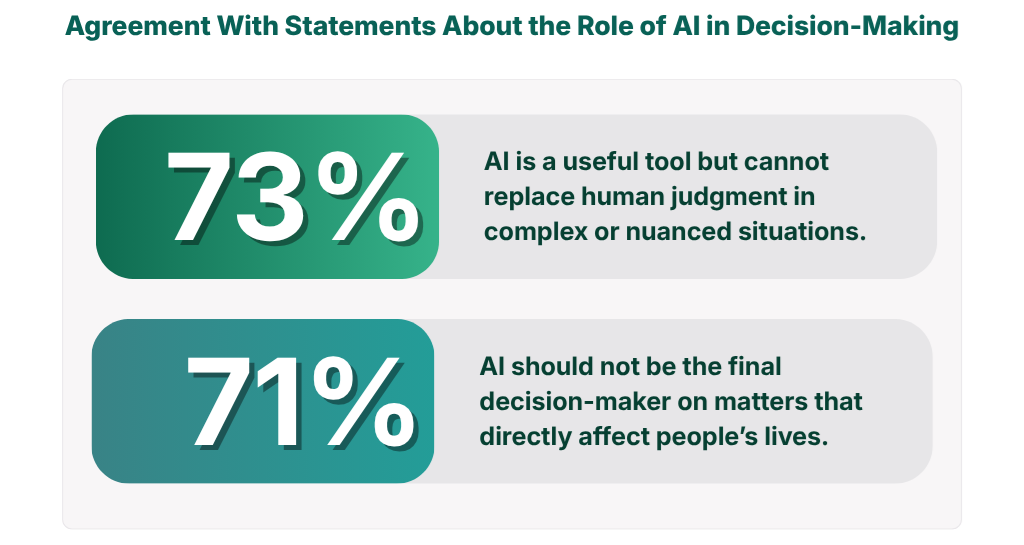
The dominant consumer view is nuanced rather than negative. Seventy-three percent of Americans agree that AI is a useful tool but cannot replace human judgment for complex or nuanced situations, and 71% say AI should not be the final decision-maker on matters that directly affect people's lives. Consumers are not rejecting AI — they are placing it. It belongs in a supporting role, with humans visibly in the loop.
Trust in AI accuracy tells a more pointed story. Only 43% of consumers agree that AI responses are accurate or truthful, and 30% actively disagree. For brands deploying AI in customer-facing applications — recommendations, sustainability claims, product information — building trust in AI accuracy is as important as the AI capability itself. Consumers encountering AI-generated content are already approaching it with skepticism, and brands that don't acknowledge that are likely compounding it.
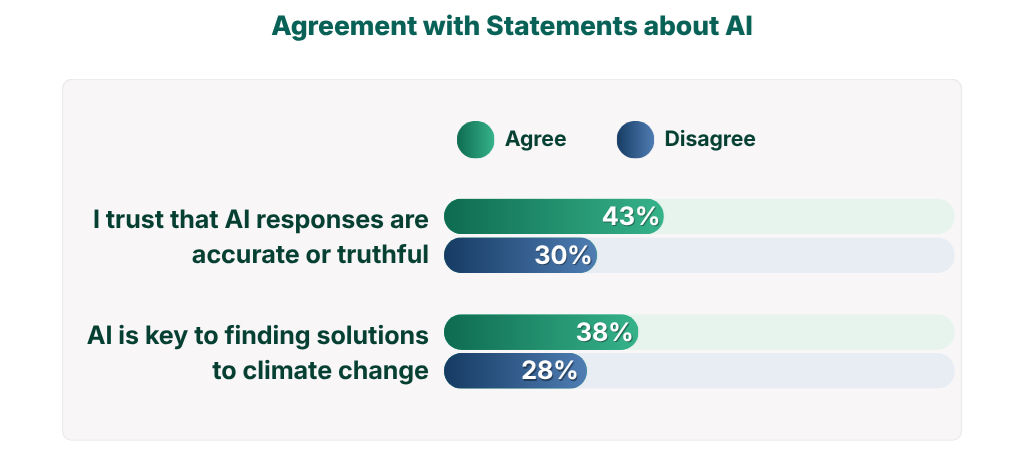
Only 38% of consumers believe AI is key to solving climate change — and 28% actively disagree. General claims that AI is helping the planet are unlikely to land with a skeptical audience.
The sustainability positioning finding is the most specific warning in the data. Only 38% of consumers believe AI is key to finding solutions to climate change, with 28% actively disagreeing. That's a consumer base that is largely unconvinced by broad AI sustainability narratives — and for brands in the sustainability space, that matters.
Companies demonstrating the more credible version of AI sustainability claims are doing so with specificity — quantified reductions in truck miles driven, verified supply chain traceability for critical materials, measurable food waste reduction. These are different claims than "we're using AI to help the planet.”
For brands, the data points to three clear lines consumers are drawing. They accept AI as a tool but expect human judgment to remain visibly part of the process. They are skeptical of AI accuracy, which means brands that show their work — explaining how AI outputs are verified — will build more credibility than those that don't. And they are not convinced that AI solves climate problems, which means sustainability claims involving AI need to be earned through specificity, not asserted through positioning.
What's the Takeaway?
AI isn't going away, which means brands need to know how to use it and how to talk about it: Keep humans involved in processes and decisions that affect people and make that visible. Verify AI outputs and communicate your safeguards. If AI is part of your sustainability story, quantify its impact — specific, measurable outcomes are the only version of this claim consumers are likely to find credible. Broad assertions that AI is helping the planet are unlikely to convince a skeptical audience, and in a sustainability context, they risk doing more damage than good.